
Safety Standards of Precast Concrete Products: Certification and Compliance
In today’s modern construction landscape, precast concrete products have revolutionized how we build — offering strength, speed, precision, and reliability. From boundary walls and manhole covers to electric poles and structural components, these factory-made concrete elements are shaping durable, efficient, and sustainable infrastructure.
However, beyond strength and design efficiency lies one crucial factor — safety. Ensuring that each precast unit meets rigorous safety standards, certifications, and compliance requirements is what guarantees performance, reliability, and public safety.
In this article, we’ll explore what safety standards mean in the precast industry, the major certifications every manufacturer should follow, and how MB Cement Products ensures uncompromising quality and compliance in every product delivered.
What Are Precast Concrete Products?
Precast concrete products are structural or non-structural components manufactured in a controlled factory environment and later transported to the site for installation. This method ensures consistent quality, precise design, and time efficiency compared to on-site casting.
Common examples include:
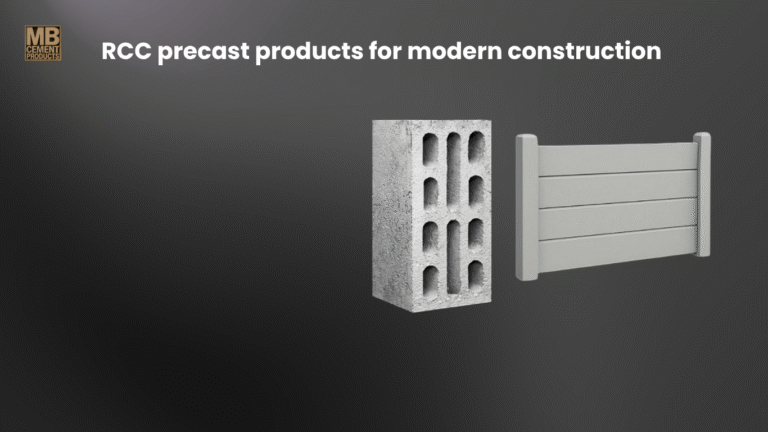
- Precast boundary walls and fencing poles
- RCC pipes and drainage chambers
- Manhole covers and slabs
- Precast beams, panels, and columns
- Utility poles used for lighting and electrification
Because these elements are manufactured off-site, they undergo strict quality control and testing before reaching the site. This makes adherence to safety standards absolutely critical — ensuring long-lasting performance, reduced maintenance, and overall structural safety.
Why Safety Standards Matter in Precast Concrete
Safety standards are not just paperwork — they are the backbone of structural integrity. Every precast element must withstand loads, weather variations, and operational stress during its service life. Without compliance, risks such as premature failure, cracking, or even accidents can arise.
Here’s why maintaining precast safety standards is vital:
- Ensures Structural Integrity: Certified precast concrete products guarantee uniform strength and dimensional precision.
- Prevents Accidents: Quality-tested materials reduce the risk of collapse, cracking, or failure on-site.
- Enhances Durability: Controlled curing and proper reinforcement minimize corrosion and environmental wear.
- Builds Trust: Certified precast suppliers like MB Cement Products are trusted by engineers and contractors for reliability.
- Meets Legal Compliance: Construction projects must comply with national and international standards such as IS, BIS, and ISO.
Safety standards not only protect end users — they also protect the reputation and responsibility of builders, contractors, and manufacturers.
Key Certifications for Precast Concrete Products
Manufacturers of precast concrete products must adhere to specific certifications and compliance codes that define safety, quality, and performance levels. Let’s look at the key certifications:
1. IS 15916 – Building Design Using Precast Concrete
This Indian Standard ensures that the design of precast structures satisfies all load-bearing and safety requirements, making it a core code for structural reliability.
2. IS 456:2000 – Code of Practice for Plain and Reinforced Concrete
A fundamental guideline for concrete construction in India, IS 456 sets standards for mix design, curing methods, and strength testing to ensure consistent quality during precast production.
3. IS 12592 – Specification for Manhole Covers and Frames
Defines load ratings and test methods for precast concrete manhole covers, ensuring their ability to handle light, medium, or heavy-duty usage safely.
4. IS 1678 – Specification for Prestressed Concrete Poles
This standard governs the design, testing, and manufacturing of RCC and PCC poles used for lighting and power transmission, ensuring strength and durability.
5. ISO 9001:2015 – Quality Management Certification
Manufacturers with ISO 9001 certification maintain a systematic production process, continuous improvement, and complete product traceability — ensuring every batch of precast materials meets consistent standards.
6. BIS Certification
The Bureau of Indian Standards (BIS) certification guarantees that manufacturers comply with the necessary quality and safety norms for all concrete-based products.
Together, these certifications ensure that precast products go through load testing, compressive strength evaluation, dimensional accuracy checks, and durability assessments — making them safe and long-lasting.
Compliance in Precast Manufacturing
Maintaining compliance isn’t a one-time action — it’s an ongoing process integrated into every production stage.
Here’s how MB Cement Products, a trusted precast manufacturer in India, ensures total compliance and quality assurance:
1. Material Testing
Every raw material — from cement to aggregates — is tested for purity, grading, and moisture content before mixing begins.
2. Controlled Production Environment
Manufacturing takes place in a factory-controlled environment, minimizing errors caused by weather or human factors.
3. Precise Mix Design
Each concrete batch follows standardized mix ratios verified through slump and strength tests to ensure optimal performance.
4. Quality Inspection
Every precast unit is carefully inspected for surface finish, shape, and dimensional accuracy.
5. Load and Strength Testing
Samples are subjected to load, bending, and impact tests to verify that they meet the required safety benchmarks.
6. Documentation and Traceability
Each batch is issued with quality certificates and test reports, ensuring full transparency and compliance documentation.
By following these steps, MB Cement Products ensures every precast component — from manhole covers to RCC poles — meets industry standards for safety, consistency, and performance.
Best Practices for Precast Safety and Quality Control
To maintain the highest safety and quality levels in precast concrete manufacturing, the following practices are crucial:
- Follow IS code mix design and curing guidelines.
- Conduct routine mold inspections for dimensional accuracy.
- Use anti-corrosive reinforcement steel.
- Perform regular compressive and load tests.
- Document all processes and inspections.
- Train workers in handling and safety protocols.
- Ensure safe transport and installation procedures.
Frequently Asked Questions (FAQs)
1. Why are safety standards important in precast concrete manufacturing?
They ensure that every structure remains stable, durable, and compliant with legal and quality norms, preventing accidents and failures.
2. What are the main certifications for precast concrete products in India?
The key certifications include IS 15916, IS 12592, IS 1678, IS 456, and ISO 9001:2015.
3. How is quality controlled in precast concrete production?
Through a combination of material testing, load tests, curing, and surface inspections before and after manufacturing.
4. Do precast products require maintenance after installation?
Only minimal maintenance is required — just periodic inspections for cracks, drainage, or alignment.
5. Why choose MB Cement Products?
Because MB Cement Products provides certified, durable, and quality-tested precast materials that meet industry safety and compliance standards.
Final Thoughts
In a fast-paced construction world, safety and quality can never be compromised. By following precast safety standards, acquiring proper certifications, and maintaining strict quality control, every structure — from small slabs to towering RCC poles — stands stronger for decades.
With MB Cement Products, you’re not just buying concrete — you’re investing in strength, compliance, and trust that truly stand the test of time.